Selective execution for high-volume analytical workloads.
Explore the potential to reduce processing time in your pipeline. BDAS recorded reductions of 79.24% and 64.71% in controlled synthetic GPU benchmarks on Isambard-AI, and 30.44% in a CPU test using pump recordings. A focused evaluation can establish the opportunity for your workload.
Measured research results · Isambard-AI · Partner enquiries
79.24%
R3 · GPU execution
Controlled synthetic workload · 5 paired repeats
64.71%
Stage C · GPU execution
60 million synthetic rows · 5 repeats
30.44%
E4B · CPU execution
294 pump recordings · 12 timing pairs
Median processing-time reductions against each test’s full-processing baseline, within defined measurement boundaries. These are separate research results; performance depends on the workload.
What BDAS does
Make avoided work count.
BDAS explores where a workload can avoid expensive processing while meeting its agreed output requirements. In the pump-recording test, it reduced processing time while matching the full-processing reference’s yes/no decisions on the evaluated recordings.
The opportunity is workload-specific. A focused evaluation measures the overall effect, including the cost of deciding which work to perform.
For a partner, the question is practical: can this approach improve the processing time, capacity or economics of your pipeline?
Conceptual routing model
Less heavy processing. A defined output contract.
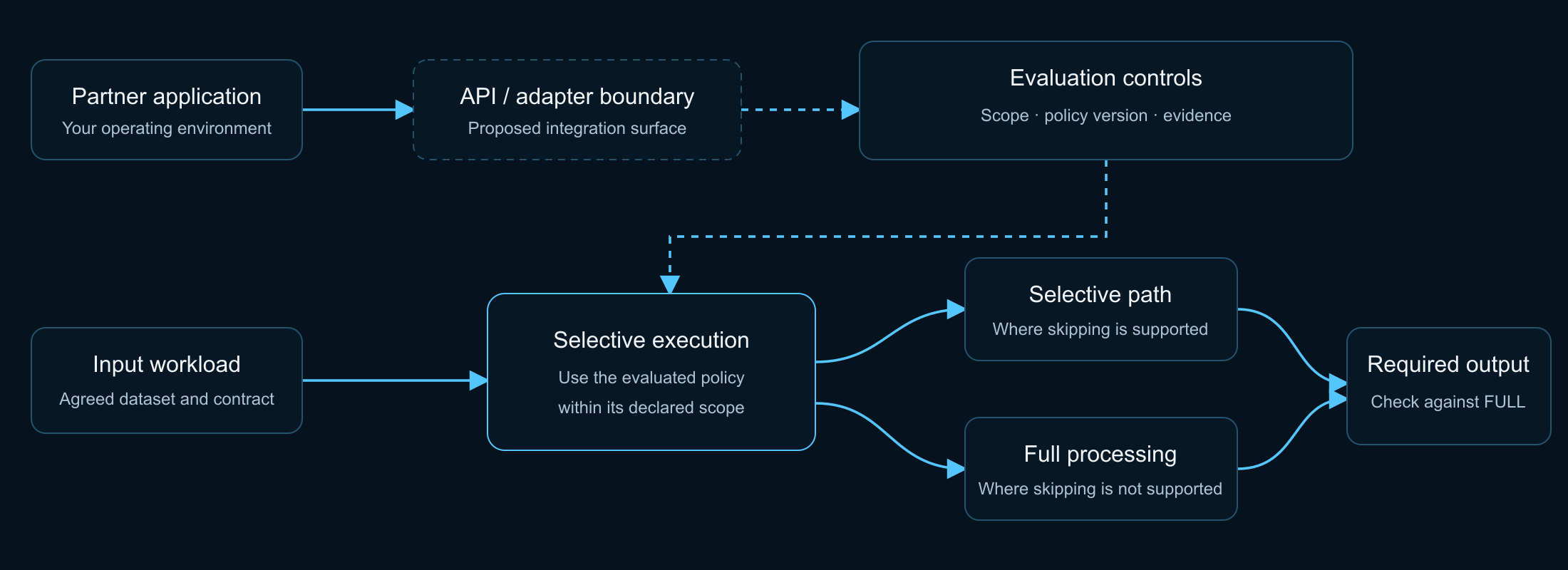
A conceptual view of workload routing. The graphic does not describe the internal method.
Open full-size diagramProposed integration approach. Interfaces and output requirements would be agreed for a partner evaluation.
Recorded execution evidence
Measured results on Isambard-AI.
Three selected research results show the potential of selective execution. Each comparison has its own workload, baseline and output requirements. Supporting evidence and measurement details can be discussed as part of a scoped technical review.
Isambard-AI · E4B · CPU
Pump-recording evaluation
294 recordings previously used in development
30.44%median paired processing-time reduction
12 out of 12 timing comparisons showed a reduction.
Matching decisions No differences in the final yes/no decisions against the full-processing reference on the evaluated recordings.
About this result
This result comes from a fixed configuration selected after earlier test results, evaluated on previously used development recordings. It measures agreement with a software reference; real-world fault-detection accuracy and fresh partner performance require separate validation.
Timing covers the measured processing path, with preparation and warm-up excluded. Additional stress-test coverage remains below the study’s required level, so the result supports further evaluation rather than production deployment.
Controlled GPU benchmarks
Demonstrating the potential at scale.
Two synthetic benchmarks recorded substantial processing-time reductions on Isambard-AI. Computed outputs matched their full-processing reference; outputs for skipped work were not produced. A partner evaluation must establish which outputs the application can legitimately omit.
R3 · GPU
Controlled synthetic workload
79.24%
median paired processing-time reduction
All five timing comparisons showed a reduction. Computed outputs matched the corresponding full-processing outputs exactly.
Stage C · GPU
60 million synthetic rows
64.71%
median processing-time reduction across five repeats
A constructed compute workload demonstrated selective execution at scale, with matching outputs for the work performed.
These are engineering benchmarks with defined timing boundaries, rather than validated customer applications. Selection adds overhead, and workloads with little opportunity to skip can run more slowly. Technical conditions and supporting records are available for scoped discussion.
What makes a result relevant to your pipeline?
Workload structure
A comparable opportunity to avoid heavy processing gives a replication pilot a relevant starting point.
Processing balance
The work avoided must outweigh selection and integration costs under the same output requirements.
Operating scale
Run frequency, eligible compute use and actual costs determine the value of a reproduced improvement.
Client savings are specific to the client pipeline. A scoped pilot agrees the required outputs and baseline, checks correctness, and measures runtime, capacity and cost impact in that environment.
Compare complete execution paths, including the cost of selecting work.
Available capacity
Establish whether saved processing creates useful headroom or throughput.
Workload economics
Assess the cost impact using your processing volumes, resource usage and operating costs. Measured runtime improvements provide a starting point for evaluating commercial value.
Workload fit
Start with one well-defined pipeline.
Industrial monitoring and batch analysis are candidate evaluation settings. Enterprise and hyperscaler applications require their own applicability and integration assessment.
Useful starting conditions
A repeatable workload and clear output requirements.
Material processing cost and representative evaluation data.
An existing full-processing baseline for comparison.
Questions to resolve early
Does selection overhead outweigh the work avoided?
Do rare events and changing inputs invalidate the policy?
Can the result transfer to your hardware and operating conditions?
Controlled evaluation
A clear path from evidence to decision.
Scope
Agree the workload, output contract and success criteria.
Reproduce
Establish a controlled evaluation environment and reproduce the reference comparison.
Validate
Check representative partner data and challenging cases against the agreed requirements.
Decide
Report correctness, performance and economics before deployment discussions.
Evidence and integration
Questions before a pilot.
How would BDAS connect to our environment?
An API or adapter can be scoped around your pipeline. The diagram shows a proposed integration approach; the interface and evaluation environment would be agreed during technical discussions.
How is technical information shared?
We begin with your workload, required outputs and evaluation goals. Supporting evidence is shared within an agreed scope, with confidentiality and permitted use established before proprietary technical material is disclosed.
Is smart skipping the same as Exact Replay?
No. Exact Replay E1 is a separate conditional caching branch. Its results are not used to support the smart-skipping performance figures on this page.
What evidence is available for a pilot?
We can discuss the recorded benchmark conditions, performance comparisons, output checks and remaining validation steps. Detailed records and technical access are scoped separately.
What did the Isambard-AI programme establish?
BDAS was evaluated on Isambard-AI using compute access awarded through UKRI AIRR. The results shown here include two synthetic GPU benchmarks and a CPU pump-recording evaluation. They are research results obtained on that infrastructure, not a third-party product validation or endorsement.
Tell us what you process, which outputs matter and where processing time affects your operation. We can discuss whether a focused evaluation is a useful next step.
Evidence summary updated 20 October 2026. Research-stage technology. Evaluation and licensing are scoped by written agreement; results are workload-specific.
NVIDIA Inception
VAREXIS Ltd is an NVIDIA Inception program member.
NVIDIA, the NVIDIA logo and NVIDIA Inception are trademarks and/or registered trademarks of NVIDIA Corporation in the U.S. and other countries.
UKRI AI Research Resource (AIRR) - Isambard-AI
Compute access awarded through the UKRI AI Research Resource for BDAS evaluation on Isambard-AI.